 Back to Main Menu




A-level maths formula sheet: mastering exams with smart strategies
When the time comes to sit your A-level maths exams, you’ll be given a formula sheet that includes all sorts of useful data you can use when answering the questions in the paper.
When the time comes to sit your A-level maths exams, you’ll be given a formula sheet that includes all sorts of useful data you can use when answering the questions in the paper.
In this article, we explore:
- Where you can find A-level mathematics formula sheets to peruse ahead of your exams
- The various formulae and other useful data you’re given on these sheets
- How these resources can help you in exams
- Other useful things you can do to prepare for your A-level maths assessments

An intro to the A-level maths formula sheet
You’ll be given a formula sheet as part of each paper you sit, but you can also find them in the following places online:
Pearson Edexcel AS and A-level maths/further maths formulae and statistical tables
AQA AS and A-level maths formulae
OCR A-level maths and further maths formulae booklets
You may find it useful to spend some time looking through these sheets as part of your revision, so you’re clear on what they include and how you will be applying these formulae when answering questions.
Also, you could use the sheet to memorise some or all of the formulae. This might help you feel fully prepared going into exams and also means you won’t have to spend time looking through the sheet to find what you need on examination day.

Key formulae on the A-level maths formula sheet
The data included in A-level exam formula booklets can help you tackle questions involving mathematical topics and concepts such as:
• Logarithms and exponentials
• Binomial expansion
• Geometric series
• Trigonometric identities
• Differentiation
• Integration
• Numerical methods, including the trapezium rule and Newton-Raphson iteration
• Standard deviation
• Kinematics
• Probability distributions
This accounts for a significant portion of the content you’re likely to come across in your A-level pure maths, statistics and mechanics exam papers, so it’s a good idea to be highly familiar with these formulae and their relevance to common types of exam questions.

Binomial expansion
For a positive integer (n), the binomial expansion formula can be written as:
(a + b)ⁿ = Σᵣ₌₀ⁿ ⁿCᵣ aⁿ⁻ʳbʳ
where ⁿCᵣ = n! / [r!(n − r)!].
This is useful when expanding expressions and finding individual terms or coefficients.

Trigonometric identities
Some of the key trigonometric identities you’ll use include:
sin (A ± B) = sin A cos B ± cos A sin B
cos (A ± B) = cos A cos B ∓ sin A sin B
These can help you simplify expressions and solve trigonometric equations.

Standard deviation
One form of the standard deviation formula for a set of values is:
σ = √[Σ(x − x̄)² / n]
Standard deviation measures how spread out a set of values is around the mean.

Kinematics
For motion with constant acceleration, commonly used kinematics formulae include:
v = u + at
s = ut + ½at²
v² = u² + 2as
Here, u is initial velocity, v is final velocity, a is acceleration, s is displacement and t is time.

Probability distributions
For a binomial random variable X ~ B(n, p):
P(X = r) = ⁿCᵣpʳ(1 − p)ⁿ⁻ʳ
with:
E(X) = np
Var(X) = np(1 − p)
These relationships are useful when working with binomial probability distributions.

Logarithms
A few core logarithm laws can also make manipulating expressions much easier:
log(ab) = log(a) + log(b)
log(a/b) = log(a) − log(b)
log(aᵏ) = k log(a)
Unlike some of the formulae above, these standard logarithm laws aren’t provided in full on the formula sheet, so they’re an example of the knowledge you’ll need to learn and remember. Knowing what’s available on your formula sheet – and what you’re expected to know yourself – can help you focus your revision and use the sheet more effectively in the exam.

Why the A-level maths formula sheet matters more than you think
One of the biggest benefits of having easy access to a range of A-level maths formulae when revising for and sitting your exams relates to the theory of cognitive load.
This is the idea that human beings only have so much working memory to dedicate to tasks at any one time. In an exam, you should be focusing as much mental energy as possible on activities that will get you marks.
To put this into context, if you’ve already used the sheet to memorise the Newton-Raphson formula, for example, it could free up some cognitive capacity for questions that ask you to apply this method to solve an equation.
Alternatively, if you find it difficult to memorise complicated formulae, you can take reassurance from knowing which ones will be available for you to check and confirm on your A-level maths formula sheet.
Perhaps most importantly, this resource – however you choose to use it – can help you work more efficiently and save time. These should always be top priorities when you only have two hours to complete a 100-mark paper.

How to use your A-level maths formula sheet for revision
As well as serving as a reference point in exams, the A-level maths formula sheet can be a useful revision tool.
Some steps you can take to ensure it’s beneficial, rather than a source of any unnecessary stress or confusion, include:
● Familiarising yourself with the sheet early on in your revision, so nothing comes as a surprise in the exam hall
● Using it regularly as a practice tool, especially when working through past papers and under timed conditions
● Working with your teacher to ensure you understand the formulae, how to use them and in what scenarios
● Highlighting the formulae you find particularly useful and rely on the most when faced with certain types of questions
● Creating your own personal copy of the A-level maths formula sheet with additional notes and pointers on putting the formulae into practice.

How tech can help you up your A-level maths game
Combining the fundamental formulae, theorems and algebraic methods of A-level maths with advanced technology approved by examination boards is a powerful strategy to do well in your exams.
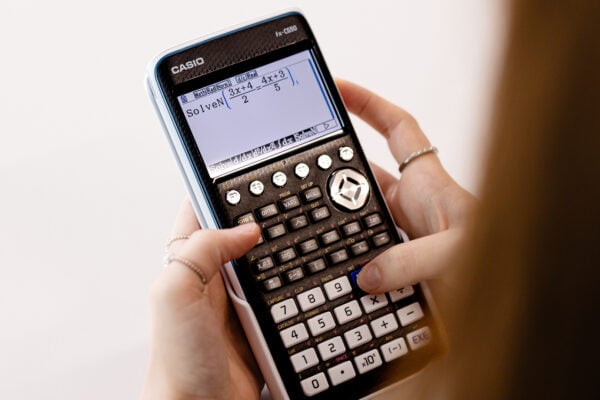
Our recommendation is for A-level students to use a graphic calculator throughout the full two years of the course. This gives you the time to build confidence with your device and ensure you can use it effectively under examination conditions. Specific applications and benefits of a graphing handset in your exams include:
● Solving equations both numerically and graphically
● Calculating and visualising probability distributions, including right-hand binomial distributions
● Performing differentiation and integration calculations
● Generating tables of values
● Calculating and graphing sequences

The formula for success in A-level maths
During your revision period, you can also take advantage of the many tools and resources available online. The Bicen Maths YouTube channel, for example, features thousands of videos and guides from maths teacher Seb Bicen, covering topics such as:
● Using the Casio fx-CG100 to improve exam accuracy
● Differentiation explained
● Statistical distributions
● Hypothesis testing
As we’re sure you’ve heard many times from your teacher, success in A-level maths in large part comes down to practice and preparation. We’re here to help with that in any way we can, including through dedicated webinars designed to support students with A-level maths revision and calculator skills. You can visit our student webinars page to explore upcoming sessions and find out what’s available. Our webinars cover a range of topics and are a great way to build your knowledge, develop your calculator skills and prepare more confidently for your exams. We look forward to seeing you at a future session, and best of luck with your revision and exams!
FAQs
A-level maths formula sheet FAQs
The formulae provided depend on your exam board and specification, but can include trigonometric identities, statistical formulae, probability distributions and kinematics formulae. It’s always a good idea to check the official materials for your course.
No. You can’t take your own formula sheet into the exam. Any formulae you’re permitted to refer to will be provided in the official exam materials, according to your exam board’s arrangements.
No. The formulae provided and how they’re presented can vary between exam boards. Check the official AQA, Edexcel or OCR formula resources for your specification so you know exactly what will be available.
Yes. Practising with your calculator and formula sheet together can help you understand when to apply different formulae, check calculations and become more confident with the processes you’ll use in the exam.
You can use the formula sheet regularly alongside practice questions and past papers. This will help you learn where key formulae are located, practise choosing and applying the right ones, and identify which formulae you still need to memorise yourself.
Blog
- Graphing technology
- Scientific calculators
- Exams
- Curriculum
- Classroom
- Students








Common mistakes in A-level statistics: probability distributions
Read more
Which Casio calculator does your class need?
Read more
Probability: key challenges and how calculators can help
Read more
Ratio: why is it such a challenge and how can a calculator help?
Read more
Moflin at MEI: how Casio’s AI companion is finding a place in the classroom
Read more
Which Casio calculator does your class need?
Read more
Probability: key challenges and how calculators can help
Read more
Ratio: why is it such a challenge and how can a calculator help?
Read more
Results day: supporting students with their next steps
Read more
Best A-level combinations: a comprehensive guide
Read more
Why is year 7 the perfect time to introduce scientific calculators?
Read more