Back to Main Menu




Probability: key challenges and how calculators can help

Probability is one of the most abstract topics students encounter at GCSE, so it’s no surprise that some have been getting in touch with us to ask how their calculator can help them navigate it.
In this blog, we explore why probability presents such a distinct challenge, and how a ClassWiz+ scientific calculator can support students once they’ve grasped the underlying concepts.
The abstract challenge at the heart of probability
Probability asks students to reason about something that, in an exam at least, they can’t see or touch.
As Casio training instructor and former teacher Simon May explains, this abstraction is the root of why this can be a demanding topic. Even straightforward scenarios – like picking a red pencil from a case of ten, two of which are red – still require students to translate a physical situation into a fraction, and understand that probabilities across all outcomes sum to one.
Before any calculation can happen, students need to correctly interpret the question, identify the sample size and the outcomes they’re interested in, and possibly construct a tree diagram or Venn diagram to model the situation. If they get the setup wrong, the maths that follows – however accurately performed – will be incorrect too.
As Simon puts it: “It’s very thought-heavy. They’ve got to read the question, understand what it’s asking, and then take information from that question and create a mathematical calculation from it.”
This is also why misunderstanding the question, rather than weak arithmetic, is a common source of errors. Students may apply the wrong sample size or misidentify what they’re being asked to calculate, particularly once questions move beyond the most straightforward setups.
Why real-world framing helps – up to a point
GCSE exam questions today tend to frame probability through familiar, relatable scenarios – coin tosses, dice rolls, sports statistics and so on – rather than the dry, contextless problems of exam papers from decades past. The idea being that students will find it easier to engage with an abstract topic when it’s made more tangible and relatable.
In the classroom, familiar objects like coins and dice are useful precisely because every student already has an intuitive starting point – everyone knows a coin has two sides. That familiarity gives students something to anchor their thinking to before the abstract maths is introduced.
The note of caution worth bearing in mind is that relatability alone doesn’t guarantee conceptual understanding. Students still need to grasp and feel confident with the model-building step – correctly setting up the tree diagram or working out the sample space, for example – regardless of how engaging the context is.
Where the calculator fits in
In a similar vein to other core maths concepts like ratio, probability is a topic where the calculator’s role is to provide support.
There’s no dedicated probability app that can solve a problem from start to finish. Many probability calculations ultimately come down to adding and multiplying fractions, but only after the problem has been modelled correctly.
Simon noted: “The calculator is purely a support tool. Students have got to understand the maths behind what they’re trying to calculate – then they can use the handset for the mechanical steps and calculations that get them to the right answer.”
Once the fundamental knowledge is in place, the ClassWiz+ range does offer some key features that are genuinely useful.
Storing and recalling variables
Multi-step probability problems – particularly those involving combined or conditional events – often require several intermediate values to be calculated, stored and combined. Rather than attempting one long calculation with multiple elements crammed into a single line, students can calculate each probability, store it as a variable and combine the stored values. This reduces the risk of input errors and makes it easier to check working at each stage, rather than at the end.
The nCr function
The combination (nCr) function is found in the Probability menu on all ClassWiz+ handsets (accessed via CATALOG). To find the number of ways of choosing r items from a group of n – for example, the number of different ways three heads can occur across five coin tosses – students enter the value of n (5), open the Probability menu, select Combination (nCr), then enter the value of r (3). This calculation gives a result of 10, meaning there are 10 different possible combinations of three heads occurring in five coin tosses.
Although factorial notation and formal combination calculations aren’t typically part of GCSE maths, higher-tier students may still encounter counting problems that introduce these ideas. Having nCr available as a direct function removes the need to calculate factorials manually, allowing students to focus on understanding what they’re counting. It’s a good example of the calculator taking care of a lengthy calculation once the underlying concept is understood.
MathBox: dice roll and coin toss simulations
ClassWiz+ scientific calculators also include the MathBox app with built-in dice roll and coin toss simulations, capable of running up to 250 trials and displaying results as frequencies or relative frequencies. This offers a considerably quieter – not to mention quicker – alternative to 30 students simultaneously throwing dice around, tossing coins and shouting out results.
It can also prove effective for introducing relative frequency. This helps students see that an experimental result won’t always match the theoretical probability, and that larger sample sizes tend to bring the two closer together.
This kind of simulation can also serve as a natural bridge to more advanced ideas. Simon suggests that simple experiments – tossing a coin five times and asking what the probability is of getting exactly three heads, for instance – give higher-tier GCSE students an accessible route into “success or failure” thinking, which lays useful groundwork for binomial probability at A-level.
Recommended resources:
In this video we will look at how to use dice rolls to simulate probability outc…
In this video we will look at how to use coin flips to simulate probability outc…
Helping students build confidence with probability
Probability will likely always be one of the more demanding topics on the GCSE syllabus, but when students are comfortable with interpreting the question and modelling the situation correctly, the calculations become far more manageable.
To explore more of what the ClassWiz+ range can do in the classroom, visit our Resource Centre.
Related Content
Recommended
Making the most of the fx-991CW+ UK for GCSE Higher maths
Read more
Exam readiness: the case for starting early
Read more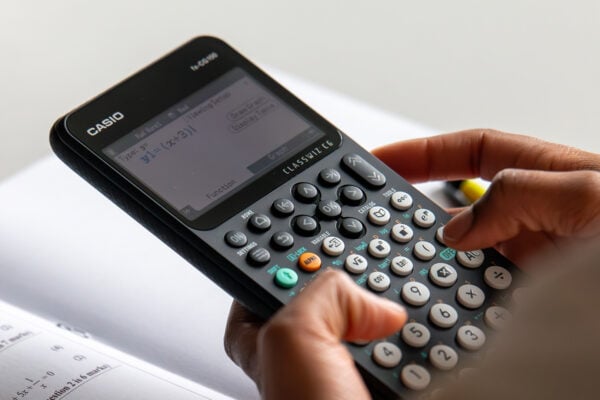
How to improve algebraic fluency at A-level
Read more