 Back to Main Menu




Exam readiness: the case for starting early

Term has barely started, but you might already feel that exams are looming on the horizon, competing for attention with everything else a new academic year brings.
From talking to many maths teachers and experienced educators over the years, we’ve found that a few small shifts early in the year can make a real difference later on, without adding to an already full plate.
Starting the year strong
James Davis, Head of KS5 Further Mathematics at Newstead Wood School, has found that introducing exam-style questions early pays off over time.
He told us that taking this focused approach from day one, rather than saving it for closer to exams, can make a real difference.
“I think that’s really important, because even if they understand the topics, they also need to know how they’re presented in exam questions,” James said. “Little and often, over the course of two years, adds up to a lot of practice. There’s really nothing to stop you looking at exam questions from the word go.”
That’s backed up by wider evidence and research. Guidance from the Education Endowment Foundation, for example, points to retrieval working best when it’s recalled repeatedly over time, rather than treated as a one-off activity.
For teachers already stretched thin, this might be reassuring. Starting early can mean less stress around finding extra time for revision and more emphasis on moments that are already happening in lessons – such as spotting and addressing gaps in understanding.
Knowing your calculator options
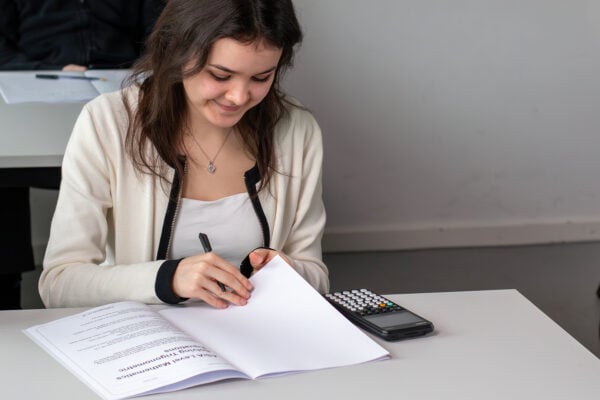
Just as early habits can shape how confident students feel come exam season, the same is true of the calculator sitting on their desk. A student who has spent years building familiarity with their calculator and using it regularly will reach for it with far more confidence when it matters most.
That makes the start of term a natural point to think about whether your classes have the right model for what they’re learning.
For those in year 7 through to GCSE, the fx-83GT CW+ and fx-85GT CW+ – our entry-level scientific calculators – provide all the core functionality needed for the whole curriculum, including:
- Fractions, decimals and percentages
- Equivalent ratio calculations
- Tables of values for up to two functions
- The Math Box app, with probability simulations, number line and unit circle display
- Statistical calculations, including quartiles and regression
Higher-tier GCSE students and those heading towards A-level may benefit from stepping up to the fx-991CW+ UK, the ultimate scientific calculator for the UK maths curriculum.
This handset has all the same features as the entry-level ClassWiz+ models and adds advanced functionality including equation solving, calculus and complex numbers.
For A-level maths and even Further Maths students, the fx-CG100 graphic calculator opens up a different way of tackling problems altogether. It offers features such as the Graph&Table app, which lets students plot a function and see the resulting graph alongside a table of values in the same view. This can help with connecting the algebra, the graph and the numbers behind topics like function transformations.
The Distribution app extends the probability work students may have started on the fx-991CW+ UK, adding a visual dimension to concepts like Binomial, Normal and Poisson distributions.
James has seen the impact of this first-hand with his A-level students: “The power of graphing technology in exams is not to be underestimated, because it allows students to constantly check their work, use graphs to visualise things and verify their answers, and just get that reassurance that they’re on the right track.”
All Casio calculators are exam-approved and permitted in UK GCSE and A-level maths papers that allow calculator use.
Building calculator fluency alongside subject knowledge
Once the right calculator is in students’ hands, the next question is how comfortable they feel using it. That tends to come from familiarity built up over time, not a crash course before exams.
This is where the consistency across our current calculator range helps. The fx-83GT CW+ and fx-85GT CW+ share the same ClassWiz interface as the fx-991CW+ UK and the fx-CG100, so students should feel comfortable moving up to more advanced models as they progress through their education.
Rose Jewell, an experienced senior examiner and A-level maths teacher, has shared a perspective on calculator proficiency based on years of marking exam scripts. She’s seen how much of a difference it makes when students have had the time to build up genuine, everyday confidence with their calculator, which supports clear written working.
“Students need to practise this idea of leaving an evidence trail and showing why their answer is what it is,” she said. “But they absolutely shouldn’t be frightened of using their calculator.”
What James and Rose both suggest is that exam success rarely comes down to one big change. It’s the accumulation of small, steady habits across years, in how students revise and how they use their calculators, that makes the biggest difference by the time exams arrive.
If you’re looking for regular support and useful materials to help you and your students get maximum value from your calculators, you can find plenty in the Casio Education Resource Centre.
Related Content

Recommended
A-level exams and calculators: pitfalls to avoid
Read more
4 steps to help A-level maths students make the most of their calculators
Read more
Best A-level combinations: a comprehensive guide
Read more